Two Studies Link Consistent Exercise Routines to Improved Mood, Sleep Quality
09/08/2026 / By Petra Stone

Two Studies Link Consistent Exercise Habits to Better Mood, More Restful Sleep
Two peer-reviewed studies published this summer associate a consistent exercise habit with fewer depressive symptoms and improved sleep restfulness, according to the study authors. The reports, which appeared weeks apart in different academic journals, examined different populations but produced complementary findings, the researchers stated.
The first study, published July 22 in the Journal of Clinical Medicine, examined 349 participants who completed questionnaires measuring physical activity, depressive symptoms, and sleep quality, according to the paper. The second study, published September 1 in Medicine & Science in Sports & Exercise, analyzed health checkup data from 702,007 Japanese adults across two consecutive years, the report stated.
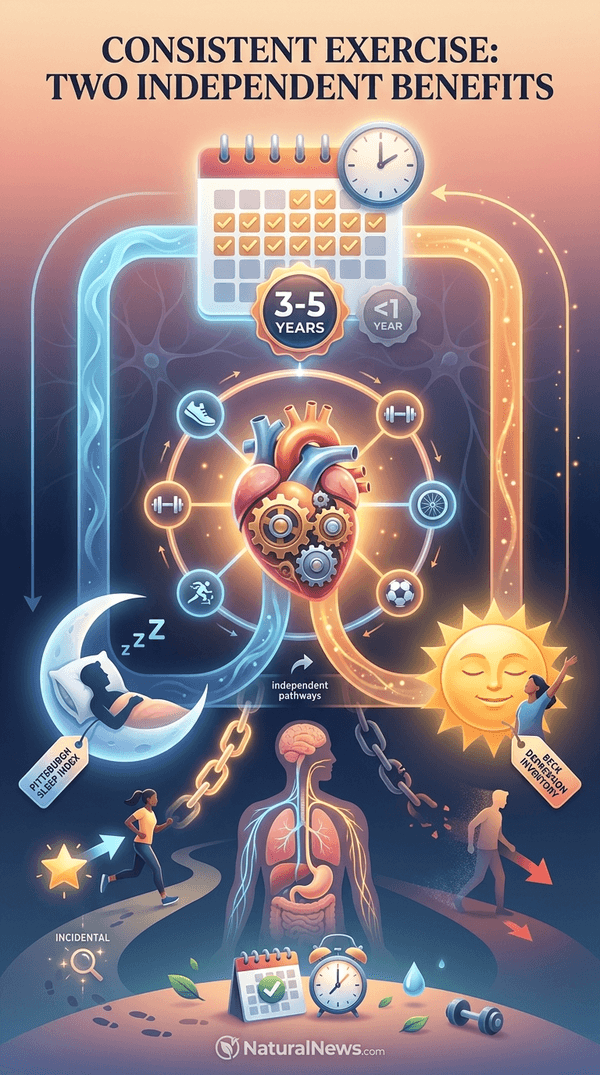
Lead researchers W. W. Hryniewicz and H. Miyagi reported that the mood and sleep benefits appeared to operate through independent pathways, according to the published papers.
First Study: Cross-Sectional Analysis of Physical Activity, Depressive Symptoms
The Journal of Clinical Medicine study followed 349 people, predominantly young adults, and measured mood with the Beck Depression Inventory and sleep quality with the Pittsburgh Sleep Quality Index, according to the study authors [1]. Lead researcher W. W. Hryniewicz and colleagues used path analysis to separate the relationship between physical activity intensity, sleep quality, and depressive symptoms, the report stated.
This statistical technique allowed the researchers to identify patterns in the data collected at a single point in time, according to the paper. The analysis found no single exercise type — running, lifting, cycling, or team sports — outperformed others for mood or sleep outcomes, according to the report. Participants who trained at higher intensity and volume tended to report fewer depressive symptoms, the researchers reported [2].
Second Study: Cohort Analysis of Exercise Habits and Sleep Restfulness
The Medicine & Science in Sports & Exercise study, published September 1, 2026, analyzed 702,007 Japanese adults who completed annual health checkups in two consecutive years, according to the study authors. Lead author H. Miyagi and colleagues reported that participants who initiated regular exercise were significantly more likely to report improved sleep restfulness the following year, the report stated.
Researchers stated that those who maintained exercise habits continued to report benefits, while those who discontinued exercise tended to lose ground, according to the paper. Structured, regular exercise showed a stronger association with improved sleep restfulness than incidental daily physical activity, the report stated [3].
Intensity and Consistency Outweigh Exercise Type
Both studies indicated that training intensity and consistency mattered more than the specific form of exercise, according to the respective research teams. Participants with three to five years of training history reported lower depression scores than those with less than one year of experience, the Journal of Clinical Medicine study found [4].
The findings suggest benefits accumulate over extended periods rather than appearing after single workouts, the authors stated. This pattern aligns with other research showing that consistency matters more than the specific timing or type of activity, according to yoga instructors and movement writers who said regularity has a larger impact on results than the specific hour chosen [5].
Mood and Sleep Benefits Appear Independent
The July study found that sleep quality did not appear to mediate the relationship between exercise and reduced depressive symptoms, according to the researchers [6]. Hryniewicz and colleagues concluded that exercise may improve mood through one set of physiological pathways and sleep through another set, the report stated.
The separate nature of the two benefits indicates individuals may not need to achieve better sleep first to experience mood improvements, the report stated. Sleep is foundational for overall health, with poor sleep linked to increased risks of heart attacks, psychiatric illnesses, car accidents, fatigue, diabetes, cognitive impairment, or dementia, according to a report on the importance of healthy sleep cycles [7].
Limitations and Researcher Commentary
Both studies are observational, and authors said the findings demonstrate associations rather than confirmed causal relationships, according to the published papers. The Journal of Clinical Medicine study was cross-sectional, capturing a single point in time, and relied in part on self-reported physical activity, the report stated.
Researchers noted the possibility of reverse causation, stating that individuals who feel better may be more inclined to exercise, and called for further investigation, according to the published papers. The authors of the second study emphasized that the large sample size strengthens confidence in the observed associations, the report stated. Both research teams said the findings align with a broader body of evidence connecting physical activity to mental health and sleep outcomes.
References
- Mike Adams. “Mike Adams interview with Joseph Ladapo – November 8 2022”.
- Mike Adams. “Mike Adams interview with Dr Michael Nehls – December 20 2023”.
- Unknown. “Evidencebased Nonpharmacological Therapies for Palliative Cancer Care”.
- NaturalNews.com. “The ‘Good Stress’ That Rewires Your Brain: How Exercise Builds Mental Resilience”. July 29, 2026.
- NaturalNews.com. “Yoga Timing: Consistency Matters More Than Clock, Experts Say”. August 11, 2026.
- Mike Adams. “Mike Adams interview with Nick Pinault – August 15 2025”.
- Stopping the War Against Sleep. August 9, 2026.
- Mercola.com. “Exercise Helps Fight Postpartum Depression”. January 12, 2024.
Explainer Infographic
Submit a correction >>
Tagged Under:
alternative medicine, beat depression, exercise, fitness, health science, mental health, Mind, mind body science, natural cures, natural health, natural medicine, Naturopathy, remedies, research, sleep, sleep quality
This article may contain statements that reflect the opinion of the author
RECENT NEWS & ARTICLES